Sketchbook, Camera or Pocket Notebook? Choose a Record You’ll Return To
Choose a sketchbook, camera or pocket notebook for an outing by the attention each invites, so recording the day stays enjoyable and easy to revisit.
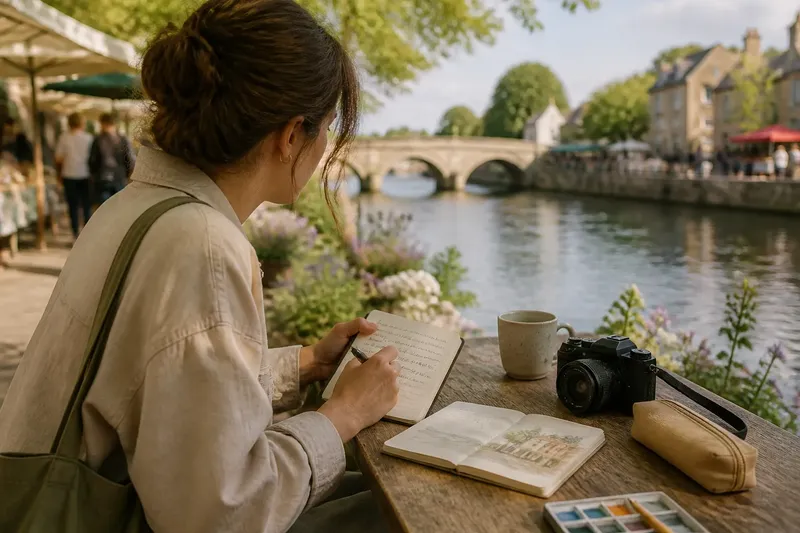
The common mistake with recording an outing is choosing the format that looks most appealing at home, then carrying it around like homework. A sketchbook, camera or pocket notebook each asks for a different kind of attention; the wrong fit can leave you watching the day through a task instead of enjoying it. The best record is the one you’ll happily pick up again.
What does each format help you notice?
A sketchbook slows you down to study shape, light and arrangement. You might notice how a café chair cuts across a window, or how a row of rooftops changes as clouds pass. Drawing need not be polished. A loose outline, a few colour patches or a map of the route can hold the character of a place.
A camera encourages you to frame moments. It is good for catching contrasts, gestures and details that may disappear quickly: rain on a bus shelter, a friend leaning over a market stall, the bright edge of a sign against brick. The frame also excludes things. That selectiveness can make a photograph vivid, but it may tempt you to look for scenes instead of joining them.
A pocket notebook is most at home with words, lists and fragments. It can preserve a funny exchange, a smell, a place name, or the thought that occurred while waiting for a train. It is less dependent on light or composition, and it works well when what mattered was not especially photogenic.
Choose by the detail you want to remember: shape, scene or thought.
Which record suits the pace of your outing?
Think about what your hands and attention will be doing. If you plan to sit in a garden or linger by a harbour, a sketchbook may fit the unhurried pace. A small pencil case keeps the setup simple; a single pen can be enough if you prefer line to colour.
A camera suits a day with changing scenes, from a walk through town to a visit with friends. A phone camera is convenient, while a dedicated camera can make taking pictures feel more deliberate. Either way, decide in advance whether you want to make a few considered frames or gather a loose visual diary. The first keeps you present; the second can be useful when you enjoy sorting images later.
A pocket notebook suits an outing with pauses, conversation or useful names to remember. It fits a museum visit, a long lunch or a wandering day when plans change. A small notebook with a firm cover is easier to write in while standing; a notes app is another option if you already reach for your phone naturally.
Match the tool to the day’s rhythm, not to an idealised version of your hobbies.
How can you record an outing without missing it?
Give the record a modest role. You do not need to document every stop or produce a complete account. Try choosing one moment to capture, then put the tool away until something else genuinely catches your attention.
For a camera, take the picture and lower the device before deciding whether to take another. With a sketchbook, make a quick study rather than waiting for a quiet hour and perfect materials. With a notebook, write a phrase or a few sensory details while they are fresh; a full diary entry can wait, if it ever feels necessary.
Imagine you spend a Saturday at a riverside market with a friend. You choose a pocket notebook, jot down the name of a stallholder’s unusual herb and note that your friend bought pears for the walk home. The expected result is a compact record tied to the conversation, not a list of every stall or a polished account of the day.
If taking notes or pictures starts interrupting conversation, let the moment pass. A record should leave room for the outing itself.
What should you do with the record afterwards?
A small return ritual can make any format more satisfying. When you get home, place the sketchbook on a shelf you use, transfer selected photos into an album, or add a date and place to the notebook page. Keep this brief. The aim is to make the record findable, not to create a second project.
For a sketch, add a few words if the scene needs context: where you were, who was there, or why you chose that view. For a photograph, a short caption can identify a location or explain an unfamiliar detail. For a note, circle a phrase you would like to remember, or mark a name to look up later.
Keep records together in a way that suits your habits. A sketchbook can stay in a visible stack, printed photographs can sit in a simple album, and notebook pages can remain in date order. Digital images may be easier to revisit if you give albums clear names rather than letting everything disappear into one camera roll.
Which format is easiest to return to?
The practical answer is the one with the least friction for you. Ask yourself what you enjoy doing even when you have little time, what you are comfortable carrying, and what you like looking back at. If you love drawing but rarely pack a bulky pad, a pocket-sized sketchbook may suit you better. If sorting images feels like a chore, a camera may not be the easiest choice, even if you like taking pictures.
You can also combine formats, but give each a clear job. A notebook might hold the day’s route and a single photograph might preserve its best view. Avoid carrying every tool just in case; extra options can turn a gentle outing into a hunt for the perfect record.
When deciding between a sketchbook, camera or pocket notebook, start with the kind of attention you want to bring to the day. Choose the format you can carry comfortably, use lightly and revisit without needing to tidy up a pile of unfinished work.
Do you need to be artistic or use special equipment?
Can I sketch if I’m not good at drawing?
Yes. A few lines, a rough map or a patch of colour can help you remember the arrangement of a place. Treat the page as a prompt for memory, not a performance.
Is a phone camera enough for an outing?
It can be, especially if your phone is already with you and you enjoy composing pictures on it. A separate camera is an option if its controls and feel make taking photographs more enjoyable for you.
What should I write in a pocket notebook?
Capture details that would be hard to reconstruct: a place name, a line from a conversation, a food you tried or a small surprise. Short fragments are useful; you do not have to write a complete diary entry.
Can I use more than one format?
Yes, if each has a simple purpose and the combination does not distract you. For example, use a sketchbook for a view and a notebook for the place name or the story behind it.